
Introduction
In modern manufacturing, assembly defects can still occur even when companies use high-precision electric tightening tools.
Many quality issues do not come from the tool itself, but from human errors during the assembly process. Common examples include:
- Missing fasteners
- Incorrect tightening sequence
- Using the wrong tightening program
- Selecting the wrong socket
- Incorrect torque settings
These errors can lead to rework, scrap, and even affect product reliability and safety.
As industries such as automotive manufacturing, new energy, electric drive systems, and industrial equipment continue to raise their requirements for tightening quality, more companies are introducing Poka-Yoke mechanisms into their tightening processes to reduce the impact of human error on assembly quality.
This article explains what Poka-Yoke means and how modern intelligent tightening systems prevent assembly errors through position control, program management, and data traceability.
What Does Poka-Yoke Mean?
Poka-Yoke originated in Japanese manufacturing. Its core concept is to prevent errors before they occur through proper process design and control methods, rather than detecting and correcting defects after they have already been created.
Unlike traditional quality control methods that rely on inspection to identify problems, Poka-Yoke focuses on preventing errors at the source. Its goal is not simply to find mistakes, but to make mistakes difficult—or even impossible—to occur.
In industrial tightening applications, Poka-Yoke is often referred to as an error-proofing system or mistake-prevention mechanism. Its purpose is to ensure that the assembly process is carried out consistently according to defined process requirements.
Why Do Tightening Systems Need Poka-Yoke?
Human error is unavoidable in any production environment. Even experienced operators may still miss fasteners, tighten the wrong position, select the wrong program, or use the wrong tool due to faster production cycles, complex product structures, or long hours of repetitive work.
As product structures become more complex and manufacturers place higher demands on quality consistency, relying only on operator training and work instructions is increasingly insufficient to ensure stable long-term assembly quality.
Traditional quality management often depends on inspection after assembly is completed. However, inspection can only identify errors that have already occurred; it cannot prevent the errors themselves. When problems are discovered in later processes or even at the customer site, companies may face additional costs such as rework, production stoppages, and quality claims.
For this reason, more manufacturers are integrating Poka-Yoke mechanisms directly into tightening processes. By replacing post-process correction with proactive prevention, companies can reduce quality risks caused by human error at the source.
What Are the Most Common Tightening Errors?
From a quality management perspective, most tightening defects are not caused by the tool failing to reach the target torque. Instead, they are often caused by missing fasteners, wrong tightening positions, incorrect program selection, or incorrect tool use during the assembly process.
These errors may appear simple, but they can seriously affect product quality, production efficiency, and final reliability. The following are the most common tightening errors in industrial assembly.
Missing Fasteners
Missing fasteners are among the most common and highest-risk quality issues in industrial assembly.
As product structures become more complex and the number of fastening points increases, operators may miss certain bolts during high-paced production. This risk is especially higher in assembly scenarios with many fastening points, such as EV battery packs, automotive seats, electric drive systems, and industrial equipment assemblies.
For example, in battery pack assembly, if a fixing bolt is missed, the structural rigidity of the battery pack may be reduced, creating loosening risks under long-term vibration conditions. In automotive seat assembly, a missed key connecting bolt may directly affect seat structural strength and user safety.
Because missing fasteners usually do not trigger equipment alarms or visibly change the product appearance, they are often difficult to detect in time. Once the defect flows into later processes, it not only increases troubleshooting and rework difficulty, but may also expose quality problems during product use, resulting in higher quality costs and management risks.
Repeated Tightening
In addition to missing fasteners, repeated tightening is another quality risk that is often overlooked in industrial assembly.
When a product has many fastening points, operators may have difficulty accurately determining which bolts have already been tightened and which ones are still pending. In such cases, the same bolt may be tightened again, or even multiple times.
For example, in EV battery pack or automotive seat assembly, when fastening points are dense and numerous, an operator may mistakenly believe that a point has not yet been completed and perform tightening again. Since the bolt is already locked, this issue may not attract attention as quickly as a missing fastener and may even be mistakenly considered harmless in many production environments.
However, repeated tightening does not mean greater safety. For assembly processes using torque control or torque-angle control, repeated tightening may disturb the original preload state and cause the actual clamping force to deviate from the design requirement.
Repeated tightening may also cause:
- Thread damage
- Abnormal preload
- Increased fastener fatigue
- Reduced component service life
In some cases, repeated tightening may develop into over-tightening, resulting in stripped threads, part deformation, or fastener failure.
Because repeated tightening usually does not trigger alarms or visibly change the product appearance, it is also difficult to detect through manual inspection. For assembly scenarios requiring high consistency and high reliability, preventing repeated tightening is just as important as preventing missing fasteners.
Wrong Tightening Position
On products with many fastening points, operators may sometimes move the tool to the wrong position for tightening.
This often happens in assembly scenarios where:
- Product structures are complex
- Fastening points are densely distributed
- Product models change frequently
- Workstation cycle times are short
For example, in EV battery pack, electric drive system, or automotive seat assembly, adjacent bolts may be very close to each other. When operators rely on experience to locate tightening points, they may accidentally tighten the wrong position, repeat a completed point, or miss the fastening point that should actually be completed.
Wrong-position tightening usually does not trigger tool alarms or visibly change the product appearance, so it is often difficult to detect in time. In many cases, the problem only becomes visible during later inspection, functional testing, or customer use.
A wrong position judgment may lead to:
- Some bolts being missed
- Repeated tightening of the same point
- Disruption of the process sequence
- Product quality not meeting requirements
For production lines using digital quality management, position errors may also cause mismatch between tightening data and actual fastening points, affecting the accuracy of later quality traceability. When the system record shows that a certain point has been completed, but the actual tightened point is adjacent to it, quality analysis and problem tracing become much more difficult.
Therefore, for products with many fastening points, a single position judgment error may affect not only one bolt, but also the execution quality of the entire assembly process and the reliability of the traceability system.
Incorrect Tightening Sequence
Many products not only require all bolts to be tightened, but also require them to be tightened in a specific sequence.
For example, in battery pack covers, flange connections, and large structural component assembly, multiple bolts often need to be tightened in a predefined sequence to apply clamping force gradually and evenly across connection areas. If an operator changes the tightening sequence arbitrarily, even if all bolts eventually reach the target torque, the expected assembly result may still not be achieved.
Take battery pack cover assembly as an example. If an operator tightens one side first instead of gradually tightening the entire perimeter according to the required sequence, uneven force may be applied to the cover, affecting the compression of the sealing material. As a result, even if all bolts show as tightened, sealing performance may decline and leakage risks may occur.
Similar problems are also common in flange connections and large structural component assembly. Incorrect tightening sequence may cause:
- Uneven clamping force distribution
- Component deformation
- Reduced sealing performance
- Lower product reliability
Therefore, for products requiring strict assembly quality control, ensuring that operators complete tightening according to the predefined sequence is an important part of error-proofing management.
Wrong Tightening Program
Modern products often contain multiple types of fasteners, and different positions may require different torque values, angle parameters, or tightening strategies. In mixed-model production environments, operators frequently need to switch tightening programs according to different products and process requirements, making program selection errors a common risk in industrial assembly.
For example, in EV battery pack assembly, some structural connection bolts may require a tightening torque of 40 Nm, while adjacent bolts may require 25 Nm. If the operator mistakenly applies the 25 Nm program to a 40 Nm bolt, the tool may show that tightening is complete, but the actual preload may be insufficient, affecting structural strength and long-term reliability.
Conversely, if a high-torque program is applied to a lower-specification fastener, it may cause thread damage, part deformation, or even assembly scrap.
Unlike missing fasteners, repeated tightening, or position errors, the special characteristic of a program error is that the operator may have tightened the bolt in the correct position and the entire process may appear normal, but the actual process parameters used do not match the design requirement. In other words, the issue is not “whether it was tightened” or “where it was tightened,” but “how it was tightened.”
For this reason, program errors are highly hidden. In many cases, the product appearance, assembly state, and even on-site inspection results may appear normal, while the actual clamping force has already deviated from the design requirement. Such problems often need to be identified through process data, parameter records, or quality traceability systems.
For industries that require strict control of assembly consistency and product reliability, ensuring that each fastening point automatically calls the correct process program has become an important part of modern tightening Poka-Yoke systems.
Incorrect Socket or Bit Selection
When one workstation needs to use multiple sizes of sockets or bits, tool selection errors are also a common quality risk in industrial assembly.
For example, in automotive seat, battery pack, or industrial equipment assembly, different bolt specifications often correspond to different socket or bit sizes. If an operator selects the wrong tool, the tightening operation may still continue, but the final assembly result may already deviate from process requirements.
In automotive seat assembly, for example, rail fixing bolts and frame connection bolts may require different socket sizes. If an operator uses the wrong socket during workstation switching, it may affect torque transmission accuracy and may also wear or damage the bolt head.
Unlike missing fasteners, position errors, or program errors, the special characteristic of tool selection errors is that the operator may have performed the correct program at the correct position, but because the socket or bit does not match the requirement, the final assembly result still fails to meet the process standard.
Similar problems may also cause:
- Abnormal torque transmission
- Fastener damage
- Surface scratches on the product
- Failure to meet process requirements
In mixed-model production environments, frequent product switching and increased tool variety further increase the likelihood of such errors. Many tool errors also do not trigger alarms immediately, so they often need to be identified and prevented through process control or tool management systems.
As product models increase and process complexity continues to rise, relying only on operator memory and manual management is no longer enough to avoid these problems. Therefore, ensuring that operators use the correct tool at the correct workstation has become an important part of modern tightening Poka-Yoke systems.
These errors may appear independent, but they often share common root causes, such as complex process flows, frequent program switching, manual position identification, and tool management challenges. As a result, relying only on training and experience management is increasingly unable to meet modern manufacturing requirements for quality consistency. To truly reduce these risks, companies need to understand the causes of errors from a system level and eliminate mistakes before they occur through Poka-Yoke mechanisms.
What Are the Common Types of Poka-Yoke in Industrial Tightening Systems?
To reduce the impact of human error on assembly quality, modern manufacturers have widely applied Poka-Yoke principles to tightening processes.
Based on the control target, Poka-Yoke in industrial tightening systems can generally be divided into position Poka-Yoke, sequence Poka-Yoke, program Poka-Yoke, tool Poka-Yoke, and process Poka-Yoke.
Although these mechanisms focus on different control points, their shared goal is to ensure that the tightening process is executed consistently according to predefined process requirements, thereby improving product quality consistency and reducing risks caused by human error.
Position Poka-Yoke
Position Poka-Yoke is used to ensure that each tightening operation occurs at the correct position. It is one of the most widely used error-proofing methods in modern tightening systems.
Although missing fasteners, repeated tightening, and wrong-position tightening appear different, they are all essentially related to point management. When the system cannot accurately confirm the current working position, these problems may occur.
To address this issue, a position Poka-Yoke system manages and verifies each tightening point. Only when the tool reaches the specified position does the system allow the tightening operation to proceed. If the current position does not meet the process requirement, the system restricts operation or provides a warning.
For example, in EV battery pack assembly, a single product often contains many fastening points. A position Poka-Yoke system can confirm the current working position in real time and record the completion status of each point, effectively preventing missing fasteners, repeated tightening, and wrong-position tightening.
As product structures and assembly processes become increasingly complex, position Poka-Yoke has become an important foundation for achieving quality consistency in modern intelligent tightening systems.
Sequence Poka-Yoke
Sequence Poka-Yoke is used to ensure that operators complete tightening operations according to the predefined process sequence, preventing skipped steps, incorrect sequence, or missed operations.
In many assembly scenarios, bolts must not only be tightened, but also tightened in a specific order to gradually apply clamping force. For example, in battery pack covers, flange connections, and large structural component assembly, different bolt positions often have clear sequence requirements.
To ensure that process requirements are correctly executed, a sequence Poka-Yoke system manages the entire tightening process according to the predefined workflow. Only after the current step is completed does the system allow the next step to proceed, ensuring that each fastening point is tightened in the required sequence.
For example, in battery pack cover assembly, the system can release the next bolt position step by step according to the predefined sequence, preventing operators from skipping steps or changing the tightening sequence arbitrarily.
Through sequence Poka-Yoke, companies can ensure consistent clamping force distribution, improve assembly quality and product reliability, and reduce quality risks caused by process execution deviations.
Program Poka-Yoke
Program Poka-Yoke is used to ensure that each fastening point is tightened with the correct process parameters, preventing quality risks caused by wrong program selection.
In modern assembly processes, different bolt positions often correspond to different torque values, angle parameters, or tightening strategies. Even if the operator tightens the correct position, the final assembly result may still deviate from design requirements if the wrong program is used.
To ensure correct process parameter execution, a program Poka-Yoke system can automatically call the corresponding program based on product model, current workstation, or operation step, ensuring that the correct parameters are applied to the correct fastening point.
Through program Poka-Yoke, companies can improve assembly consistency, reduce quality risks caused by program misselection, and ensure that every tightening operation follows predefined process requirements.
Tool Poka-Yoke
Tool Poka-Yoke is used to ensure that operators use the correct socket, bit, or tool accessory at the correct workstation.
In modern assembly environments, a single workstation often needs to manage multiple fastener specifications, and different bolts may correspond to different socket or bit sizes. Even if the tightening position and program are correct, using the wrong tool may still cause the final assembly result to fail to meet process requirements.
To prevent tool selection errors, a tool Poka-Yoke system identifies and verifies the current tool status and confirms whether it matches the current process requirement. Only when the correct tool is selected does the system allow subsequent operations to continue.
Through tool Poka-Yoke, companies can effectively prevent wrong socket selection, wrong bit selection, and mismatch between tools and processes, improving assembly quality and process consistency.
As product models increase and demand for flexible production continues to grow, tool Poka-Yoke has become an important part of modern intelligent tightening systems.
Process Poka-Yoke and Quality Traceability
Position Poka-Yoke, sequence Poka-Yoke, program Poka-Yoke, and tool Poka-Yoke can effectively reduce the probability of human error. However, modern manufacturers do not only need to prevent errors; they also need to verify whether each tightening operation truly meets process requirements.
For this reason, more companies are incorporating process monitoring and quality traceability into their Poka-Yoke systems.
Process Poka-Yoke can monitor key tightening parameters in real time, such as torque value, angle value, operation result, and process status. When parameter abnormalities or nonconforming results are detected, the system can immediately trigger an alarm, stop the process, or prevent the product from moving to the next operation, thereby stopping defects from flowing downstream.
At the same time, a quality traceability system can automatically record the data of each tightening operation, including product ID, operation time, process parameters, operation result, and operator records, and link this data to the specific product.
Through process Poka-Yoke and quality traceability, companies can identify and control quality risks in time, quickly locate causes when problems occur, improve quality management efficiency, and meet modern manufacturing requirements for process traceability.
As industries such as automotive, new energy, electric drive systems, and high-end equipment manufacturing continue to raise their requirements for quality consistency, process monitoring and traceability have become indispensable parts of modern intelligent tightening systems.
Why Do Companies Need a Complete Poka-Yoke Closed Loop?
Position Poka-Yoke, sequence Poka-Yoke, program Poka-Yoke, tool Poka-Yoke, and process Poka-Yoke can each reduce the probability of specific types of errors. However, in real production environments, assembly risks are often not isolated.
For example, even if the operator reaches the correct position, the product may still fail to meet process requirements if the wrong program is called. Even if the program is correct, using the wrong tool may still affect final assembly quality. Similarly, even if the position, program, and tool are all correct, quality issues may still flow into later processes if process monitoring and result verification are missing.
This means that a single Poka-Yoke mechanism usually solves only part of the problem and cannot cover all risks across the entire assembly process.
Therefore, modern manufacturers are no longer focused only on one independent error-proofing function. Instead, they are increasingly concerned with how to integrate position control, sequence management, program calling, tool identification, process monitoring, and quality traceability into one system to achieve full-process control from operation guidance to result verification.
For modern manufacturers, the goal of Poka-Yoke is also shifting from “detecting errors” to “preventing errors.” Companies not only need to ensure that products are assembled correctly, but also need to prove that products were assembled according to the correct process.
For this reason, more companies are building closed-loop Poka-Yoke systems that cover the entire assembly process. By managing people, tools, processes, and data in a unified way, they can achieve a more stable, controllable, and traceable assembly process. This is the fundamental difference between modern intelligent tightening systems and traditional single-point error-proofing devices.
How KURAN Builds a Complete Tightening Poka-Yoke Closed Loop
The previous sections explained common Poka-Yoke methods in industrial tightening and why modern manufacturers increasingly need a complete error-proofing closed loop.
However, for companies, the real challenge is not only understanding the concept of Poka-Yoke, but also integrating position control, sequence management, program calling, tool identification, process monitoring, and quality traceability into actual production.
To achieve this, KURAN integrates intelligent positioning torque arms, control systems, error-proofing devices, and data management platforms into a unified system, building an intelligent tightening solution that covers the entire assembly process.
Through coordinated management of position, program, tool, process, and data, KURAN helps companies reduce human error and achieve full-process closed-loop management from operation guidance and process control to quality traceability.
Achieving Position Poka-Yoke with Intelligent Positioning Torque Arms
Position errors, missing fasteners, and repeated tightening are among the most common human errors in industrial assembly.
To address these issues, KURAN has developed intelligent positioning torque arm systems with position detection capabilities, including the KR001 dual-axis torque arm, KR001 linear push torque arm, KR006 carbon fiber torque arm, KR007 high-torque linear torque arm, KR008 side-mounted torque arm, and KR010 gantry torque arm.
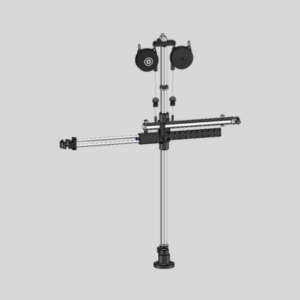
These torque arms can integrate XY or XYZ position sensors to monitor tool position in real time and work together with the control system to verify whether the current working point is correct.
Only after the operator reaches the specified position does the system allow the next tightening action to proceed, effectively preventing:
- Missing fasteners
- Repeated tightening
- Wrong-position tightening
- Skipped process steps
For assembly scenarios with many fastening points, such as EV battery packs, automotive seats, electric drive systems, and large industrial equipment, this position Poka-Yoke capability can significantly improve assembly consistency.
Achieving Program and Sequence Poka-Yoke with Intelligent Controllers
Even when the operator reaches the correct position, assembly quality still cannot be guaranteed if the wrong program or wrong process sequence is used.
The KURAN KR002-H01 intelligent controller can automatically call the corresponding process program according to the product model and manage the entire tightening workflow.

The system can configure different product requirements, including:
- Torque parameters
- Angle parameters
- Tightening sequence
- Point information
Operators no longer need to rely on memory to select programs. The system guides them to complete operations according to the predefined workflow.
For mixed-model production scenarios, this automated program management mechanism can effectively reduce quality risks caused by program misselection and sequence errors.
Achieving Tool Poka-Yoke with Intelligent Selectors
In actual production, wrong socket selection, wrong bit selection, and incorrect tool use are also common quality problems.
To solve these issues, KURAN has developed the KR004 intelligent selector, KR004-CX program selector, and KR004-SJ locking bit intelligent selector.

The system can automatically identify the selected socket or bit and switch to the corresponding program.
If the tool configuration does not match the process requirement, the system can prevent the operation from continuing.
This mechanism can effectively prevent:
- Wrong socket selection
- Wrong bit selection
- Mismatch between program and tool
- Incorrect torque parameter calling
thereby further reducing human operation errors.
Achieving Real-Time Quality Verification with Process Monitoring
Poka-Yoke is not only about preventing errors, but also about verifying whether each tightening operation truly meets process requirements.
The KURAN system can monitor key parameters in real time, including:
- Torque value
- Tightening angle
- Program information
- OK/NG result
- Operation status
At the same time, feedback devices such as the KR004-3SD three-color light can display the current operation status to operators in real time.

When an abnormal condition is detected, the system can immediately trigger an alarm and prevent the workpiece from flowing into the next process.
Compared with traditional final inspection, this real-time process control identifies problems earlier and reduces quality losses.
Achieving a Quality Closed Loop with Data Traceability
Modern manufacturers not only need to ensure that products are assembled correctly, but also need to prove that products were assembled according to the defined process.
The KURAN intelligent control system can automatically record key data from each tightening process, including:
- Product ID
- Point information
- Torque result
- Angle result
- Operation time
- Operator record
All data can be uploaded to a database for long-term storage and traceability.
When quality issues occur later, companies can quickly query the complete assembly record of the corresponding workpiece, improving problem analysis efficiency and reducing quality risks.
From Single-Point Poka-Yoke to Full-Process Quality Control
From intelligent positioning torque arms to program management systems, and from tool Poka-Yoke to data traceability, KURAN provides not just an error-proofing device, but an intelligent tightening system that covers the entire assembly process.
By managing position, tool, program, process, and data in a unified way, companies can transform assembly processes that traditionally relied on operator experience into standardized production processes that are verifiable, traceable, and continuously optimizable.
This is why more companies in automotive manufacturing, new energy, electric drive systems, and high-end equipment manufacturing are adopting intelligent tightening systems.
Conclusion
In modern industrial assembly, human error remains an important factor affecting tightening quality. Whether it is missing fasteners, wrong-position tightening, wrong program selection, or incorrect tool use, these issues can lead to product quality problems, increased rework costs, and reduced production efficiency.
The core value of Poka-Yoke is not simply detecting errors, but preventing them before they occur. Through position control, program management, tool identification, sequence control, and data traceability, companies can integrate error-proofing mechanisms directly into the assembly process and build a more stable, controllable, and repeatable tightening process.
As industries such as automotive manufacturing, new energy, electric drive systems, battery packs, and industrial equipment continue to raise their requirements for assembly quality, more companies are shifting from traditional manual management to intelligent Poka-Yoke management. A complete intelligent tightening system not only reduces risks caused by human error, but also helps companies improve product consistency, enhance quality traceability, and provide reliable data support for continuous process optimization.
If your production line is facing missing fasteners, wrong-position tightening, inconsistent process execution, or quality traceability challenges, KURAN can provide a targeted intelligent tightening Poka-Yoke solution based on your product structure, torque range, workstation layout, and process requirements.
Whether you are working with a single assembly workstation or a complex multi-station production line, our engineering team can help you evaluate your current process and develop a Poka-Yoke solution better suited to your real application needs.
Contact KURAN today to discuss your tightening application and learn how intelligent Poka-Yoke solutions can improve your assembly quality and production efficiency.