
Introduction
In modern industrial assembly, high-torque tightening tools are widely used in automotive manufacturing, battery pack assembly, construction machinery, and various heavy equipment production processes. These tools can deliver stable and precise torque output, but they also generate significant reaction forces, making them increasingly difficult for operators to control during operation.
On actual production lines, operators often experience difficulty maintaining a stable grip on the tool. During tightening, the tool may shift or vibrate, while the wrists and arms are subjected to substantial physical load. After prolonged operation, fatigue increases significantly. As torque levels continue to rise, these problems become more pronounced, and even experienced operators struggle to maintain consistent control over time.
On the surface, this may appear to be an issue of operator skill. In reality, however, the reaction forces generated by high-torque tools often exceed the range that the human body can reliably and continuously control. To truly solve this problem, it is necessary to analyze it systematically from the perspectives of mechanical principles, ergonomics, and process control.
Why High-Torque Tools Become Difficult to Control
The fundamental reason high-torque tools are difficult to control lies in the reaction forces inherently generated during operation.
Whenever a tightening tool applies torque to a fastener, the tool itself simultaneously experiences an equal and opposite reaction torque. This is a basic law of mechanics and an unavoidable physical phenomenon present in all torque tools.
This means that the greater the output torque, the greater the reaction force the operator must withstand. At lower torque levels, operators can usually maintain tool stability through arm strength alone. However, as torque increases, the reaction force quickly exceeds the level that the human body can continuously and consistently resist.
In real assembly operations, these forces are transferred directly through the tool handle to the operator’s wrists, forearms, and shoulders. Once the body can no longer effectively counteract these forces, the tool may suddenly twist, swing, or deviate, leading to loss of control.
Therefore, loss of control with high-torque tools is not an occasional issue, nor is it simply caused by insufficient operator skill. It is a direct result of the physical characteristics associated with high torque output. The higher the torque, the more difficult the tool becomes to control. This is a fundamental engineering challenge faced in all high-torque assembly processes.
Why the Human Body Cannot Reliably Control High-Torque Tools Over Time
From an ergonomic perspective, the human body was not designed to continuously resist high-intensity reaction forces. Although operators can attempt to control tightening tools through grip strength, body posture, and physical support, these capabilities are inherently limited by human physiology.
First, human muscle strength is not constant. During continuous operation, the output capability of the wrists, forearms, and shoulders fluctuates over time. Even under identical working conditions, it is extremely difficult to maintain exactly the same level of stability in every tightening cycle.
Second, fatigue significantly reduces control capability. The continuous reaction forces generated by high-torque tools steadily increase muscular strain. As working time extends, the operator’s strength, reaction speed, and movement precision gradually decline, increasing the likelihood of tool deviation and unstable positioning.
In addition, there are significant differences between individual operators. Physical strength, operating habits, experience, and overall physical condition all influence a person’s ability to control the tool. As a result, even when using the same equipment and process, different operators may produce substantially different assembly results.
Even highly experienced operators can only reduce these effects to a certain extent; they cannot fundamentally eliminate the instability inherent to the human body itself. As torque levels and workload intensity increase, these differences become even more pronounced.
From an engineering standpoint, the human body is therefore not a stable or reliable reaction-force control system. Any assembly process that depends on operators directly resisting high-torque reaction forces will struggle to achieve long-term consistency, repeatability, and high-precision control.
What Problems Can Tool Instability Cause?
When operators cannot maintain stable control of high-torque tools, the consequences extend far beyond simple operational difficulty. In actual production environments, this instability directly affects product quality, production efficiency, and operator health, ultimately increasing overall operational costs.
Reduced Tightening Accuracy
If the tool shifts or vibrates during tightening, the contact condition between the socket and fastener becomes unstable, affecting actual torque output and final preload consistency. Even highly accurate tools cannot fully compensate for errors caused by unstable mechanical positioning.
Missed Tightening, Incorrect Tightening, and Rework
When operators must simultaneously resist reaction forces and remember complex assembly sequences, their attention can become divided. This increases the risk of missed fasteners, incorrect tightening sequences, or improper parameter selection. These problems increase inspection and rework costs and may even allow defective products to reach downstream processes or customers.
Occupational Health Risks
At the same time, operators subjected to continuous high reaction forces are more likely to experience fatigue and injuries in the wrists, elbows, and shoulders. Repetitive high-load operations increase occupational health risks, which can negatively affect workforce stability and overall production management.
Reduced Production Efficiency
Loss of tool control also reduces production efficiency. Operators often need to repeatedly adjust their posture and reposition the tool to maintain stability, resulting in longer cycle times, extended training periods for new workers, and inconsistent production rhythm.
More importantly, these issues eventually translate into product quality risks. Unstable tightening quality may lead to joint failure, abnormal noise, loosening, or even structural safety hazards. This is particularly critical in industries such as automotive manufacturing, battery systems, and other high-reliability equipment sectors.
Therefore, instability in high-torque tools is not merely an operational issue. It is a systemic problem that simultaneously affects quality control, production efficiency, occupational safety, and customer satisfaction.
Why Training Alone Cannot Solve the Problem
When high-torque tools become difficult to control, many companies instinctively respond by increasing operator training, hoping that improved skills will enhance tightening quality. Training can certainly help operators become more familiar with tool operation and reduce some operational mistakes, but it cannot fundamentally solve the core challenges of high-torque assembly.
Training Cannot Eliminate Reaction Forces
First, training cannot eliminate the reaction forces generated during operation. No matter how experienced an operator may be, whenever a tool outputs torque, an equal and opposite reaction torque will always be produced. This mechanical phenomenon cannot be changed through improved operating skills.
Training Cannot Support Tool Weight
Second, training cannot support the physical weight of the tool itself. With heavy electric or pneumatic tightening tools, operators must not only resist reaction forces but also continuously support the tool’s weight. As working time increases, muscular fatigue remains unavoidable, and control stability gradually declines.
Training Cannot Guarantee Consistent Motion Paths
In addition, training cannot ensure perfectly consistent movement trajectories during every operation. Even highly skilled operators are still affected by posture changes, fatigue levels, and individual physical differences, all of which introduce variations in tool movement and positioning accuracy.
Training Cannot Provide Error Proofing or Data Traceability
More importantly, training alone cannot provide automatic error proofing or process traceability. Modern assembly processes often require tightening sequence control, automatic program switching, prevention of missed or incorrect tightening, and full-process data recording. Relying solely on human memory and experience is clearly insufficient for these requirements.
The Problem Is Fundamentally a System Engineering Issue
Therefore, the control challenges associated with high-torque tools are not simply caused by insufficient training. They are fundamentally system engineering problems involving mechanical support, ergonomics, and process control. Only through appropriate mechanical structures and intelligent control systems can companies achieve stable, repeatable, and traceable high-quality tightening processes.
How Torque Reaction Arms Help Operators Regain Control
To fundamentally solve the control problems associated with high-torque tools, operators must first be freed from directly resisting reaction forces. One of the most effective ways to achieve this is by introducing a torque reaction arm into the tightening workstation.
A torque reaction arm is a mechanical support device specifically designed for tightening tools. Its primary function is to absorb and transfer the reaction forces generated by the tool, shifting the load away from the operator’s wrists and arms and into the mechanical structure itself. As a result, operators no longer need to rely on their own strength to resist high reaction torque and only need to guide and position the tool.
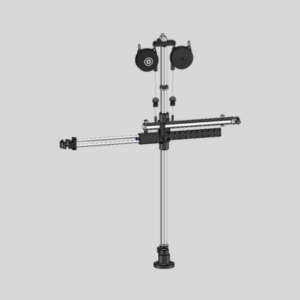
In addition to managing reaction forces, torque reaction arms can also support the weight of the tool itself. By incorporating spring balancers, pneumatic balancing systems, or lightweight structural designs, the arm allows the tool to remain suspended and balanced within the working area, significantly reducing operator fatigue. KURAN’s KR001 and KR006 series reaction arms, for example, utilize balancing mechanisms specifically designed to reduce tool weight and improve ergonomic performance.
At the same time, reaction arms provide controlled tool movement paths. Whether using dual-axis structures, linear push designs, or carbon fiber folding structures, the arm helps restrict the tool to stable and predictable movement within a predefined range, reducing posture fluctuation and random deviation while improving tightening consistency and repeatability.
The direct benefits of this mechanical support include:
- Significantly reduced wrist and shoulder fatigue
- Reduced tool vibration and deviation
- Improved tool positioning stability
- Better tightening accuracy and consistency
- Lower long-term occupational injury risk
From an engineering perspective, the value of a torque reaction arm lies not simply in making the tool feel lighter, but in allowing the mechanical structure to take over reaction forces and weight loads that the human body cannot reliably manage. This creates a far more controllable tightening process.
Mechanical support is therefore the first step toward solving high-torque tool instability. Only after reaction forces and tool weight are effectively managed can companies move toward higher levels of quality control and process optimization.
A Reaction Arm Alone Is Not Enough
Although torque reaction arms effectively solve the mechanical control challenges associated with high-torque tools, this is only the first step toward achieving high-quality tightening processes. In modern manufacturing environments, the challenge is not merely whether the tool is easy to control, but whether the entire tightening process can consistently follow the intended procedure.
By using a reaction arm, companies can transfer reaction forces and tool weight away from operators, significantly improving operational stability and ergonomics. However, the reaction arm itself has no process control capability. It cannot determine whether the operator followed the correct tightening sequence, automatically switch programs for different products, prevent missed or incorrect tightening, or record process data.
In real production environments, many quality problems are caused not by unstable tool control but by inconsistent process execution. Examples include:
- Operators failing to follow the required tightening sequence
- Incorrect tightening programs being selected during product changeovers
- Wrong sockets or bits being used
- Fasteners being tightened without traceable process records
These problems cannot be solved through mechanical devices alone. They require a more comprehensive process control system.
Modern manufacturing requirements have evolved from simply “tightening the fastener” to ensuring the process can be controlled, verified, and traced. Beyond mechanical stability, companies increasingly require:
- Tightening sequence control
- Automatic multi-program switching
- Socket and bit error proofing
- Real-time status indication
- Historical data recording
- Integration with MES and other management systems
Therefore, while torque reaction arms are an essential foundation for solving high-torque operation problems, they are not a complete solution by themselves. Truly stable and reliable assembly systems require the integration of mechanical support with digital process control to create a comprehensive tightening system covering operation, process management, and data traceability.
A Complete Intelligent Tightening Workstation Solution
To truly solve high-torque assembly control problems, improving tool stability alone is not enough. Modern manufacturers require more than an individual reaction arm — they need a complete tightening system capable of mechanical support, process control, error proofing, and data traceability simultaneously.
KURAN developed its standardized intelligent tightening workstation solution based on this concept. The system integrates torque reaction arms, digital controllers, error-proofing devices, and data management software into a unified platform, ensuring every tightening operation is completed in a controlled, verifiable, and traceable manner.
Within this system:
- Torque reaction arms absorb reaction forces, support tool weight, and stabilize tool movement
- Intelligent controllers manage tightening programs, positioning guidance, and data recording
- Program selectors allow rapid switching between product-specific tightening parameters
- Intelligent selectors and locking bit systems prevent incorrect socket or bit selection
- Three-color signal towers provide real-time status indication for OK, warning, and abnormal conditions
- Industrial control handles improve ergonomic operation
- Data management systems bind torque, angle, curve, and result data to each product for complete traceability
KURAN’s KR002-H01 supervisory controller supports product-image-based point guidance and records tightening positions, torque, angle, curves, and results. It also supports barcode-based program selection and integration with various peripheral devices. The KR002-B01 field controller provides efficient digital control capability and is compatible with multiple sensor-equipped reaction arms.
As a result, KURAN provides not just individual equipment, but a complete intelligent tightening ecosystem. By integrating mechanical structures, control logic, error-proofing mechanisms, and digital management into a unified platform, KURAN helps manufacturers improve tightening accuracy, production efficiency, process consistency, and quality traceability simultaneously, enabling truly intelligent assembly workstations for modern manufacturing.
Which Companies Need This Type of Solution Most?
Not every assembly workstation requires a complete intelligent tightening system. However, for companies with high demands for tightening quality, process control, and production efficiency, these systems can provide significant benefits.
High-Torque Tightening Applications
High-torque tightening stations are the most typical application scenario. When tool output reaches several dozen Newton-meters or more, reaction forces and tool weight often exceed what the human body can reliably control over time. Torque reaction arms combined with intelligent control systems can greatly improve operational stability and reduce quality variation.
Frequent Product Changeovers
Production lines handling multiple product specifications are also ideal candidates. Different products often require different torque parameters, tightening sequences, and tool configurations. Relying on operator memory and manual switching increases the risk of mistakes. Program selectors, barcode-triggered program loading, and automatic switching functions significantly reduce human error.
Industries Requiring Strict Quality Consistency
Industries such as automotive manufacturing, new energy battery systems, electric drive systems, aerospace, and high-end equipment manufacturing require stable and repeatable tightening processes. Even small process deviations can affect final product reliability and safety.
Production Processes Requiring Error Proofing
Companies that need strong error-proofing capabilities also benefit substantially. When production processes involve risks such as missed tightening, incorrect tightening, wrong socket selection, or incorrect program calls, intelligent selectors, position monitoring systems, and status indicators can effectively prevent these problems.
Full Process Data Traceability Requirements
More manufacturers are also requiring complete process traceability. By recording torque, angle, tightening curves, and results for every fastener, companies can link quality data directly to specific products for process audits, root-cause analysis, and after-sales tracking.
Reducing Labor Intensity and Injury Risks
Finally, companies aiming to reduce operator workload, fatigue, and occupational injury risks can gain significant value from these systems. Through mechanical support and ergonomic optimization, operators no longer need to directly bear reaction forces or tool weight, greatly improving both working conditions and operational stability.
Overall, if your production environment involves high-torque tightening, frequent model changes, strict quality consistency requirements, strong error-proofing demands, high traceability requirements, or a desire to improve operator working conditions, implementing torque reaction arms together with intelligent tightening workstations is typically a highly worthwhile solution.
Conclusion
The real challenge is not simply controlling the tool itself, but controlling the entire tightening process. The fundamental reason high-torque tools become difficult to control is that their reaction forces exceed the level the human body can reliably withstand over time. As a result, operator training alone cannot fundamentally solve the problem.
Torque reaction arms solve the mechanical control aspect, while intelligent control systems provide sequence management, error proofing, and data traceability. Only by combining these two elements can manufacturers establish stable, verifiable, and traceable modern tightening processes while simultaneously improving quality consistency, production efficiency, and operational safety.
Get a Complete Intelligent Tightening Solution from KURAN
KURAN specializes in the development and application of intelligent tightening workstation systems, providing complete solutions including torque reaction arms, intelligent controllers, error-proofing modules, and data traceability software.
Whether you are facing difficulties controlling high-torque tools, unstable tightening quality, or the need for higher levels of automation and digital process management, KURAN can provide professional system design and selection recommendations based on your specific production requirements, helping you build more precise, efficient, and intelligent assembly workstations.